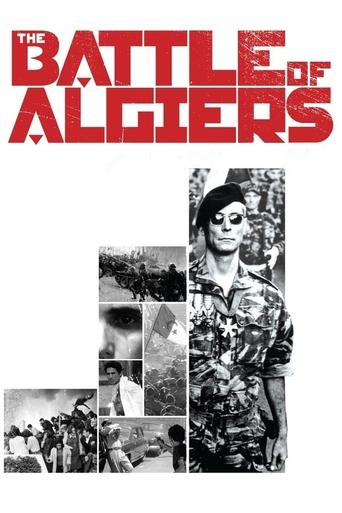
The Battle of Algiers
Where the DNA of The Battle of Algiers travels
Films it shaped
-
For me personally, I referenced a bunch of documentaries, and also things like The Battle of Algiers because there’s a lot of propaganda in the movie on both sides, and there’s also the very real human element to a revolution.
-
For the beginning, we watched The Battle of Algiers with the crew. Not because of the subject matter, but the journalistic camera, the way Pontecorvo creates the sense of reality from a subjective point of view, but also this sort of immediate chaos.
-
It’s a story about human beings. We did a lot of research, about the minutiae of the dust, the sounds, the smells, the collapse, the survival. I’d love to take credit for it, but a lot of people contributed to it. It’s almost a pseudo-documentary. Sort of like The Battle of Algiers in a way, or Missing.
-
My template for Redacted was based on the fact that these kids are making their own movies, like they made them in the Vietnam War, and these movies were getting on the internet. And so it brought up the possibilities of how to integrate all this disparate material. At one point in the movie I refer to it. Somebody says, 'this is like The Battle of Algiers.' And it does have an interesting connection to The Battle of Algiers because it’s a modern look at guerrilla warfare.
-
I spent a lot of time watching films like 'The Battle of Algiers', 'Reds', 'Nashville', 'Apocalypse Now', a lot of films from the 70s. Also films like 'The Emigrants' and 'The New Land' (two Swedish films, a Bergman movie and an Astrakhan movie, by Jan Troell) which are just about people trying to survive and keep their family together. That kind of thing.
-
I liked The Battle of Algiers for the documentary feel and the hand-held approach.
-
We also looked at classics like 'The Battle of Algiers' because it's like a docu-drama. We also looked at films by Kurosawa, like 'Seven Samurai', in terms of character and storytelling.
-
The two main ones are The Battle of Algiers, for example, and The Human Condition by Kobayashi.
-
Apocalypse Now Atlas note
As Francis Ford Coppola descended into the logistical madness of filming his Vietnam epic, he looked to Werner Herzog's Aguirre, the Wrath of God as his absolute spiritual and aesthetic lodestar. Coppola was mesmerized by Herzog's hallucinatory depiction of a megalomaniac drifting down a jungle river into absolute madness, consciously mirroring its hypnotic, fever-dream pacing for Captain Willard's journey. Furthermore, the chaotic, documentary-style immediacy of the film's early combat sequences was directly inspired by Gillo Pontecorvo's The Battle of Algiers, from which Coppola sought to replicate the terrifying, unvarnished chaos of asymmetrical warfare. The resulting epic completely transcends the traditional war film, operating instead as a surrealist descent into the darkest corners of the human psyche.
-
The Bourne Ultimatum Atlas note

Director Paul Greengrass explicitly cited Gillo Pontecorvo's The Battle of Algiers (1966), the Italian-Algerian political thriller shot in documentary-style verite. Greengrass absorbed Pontecorvo's approach to staging chaos, hand-held cameras, crowded streets, violence that erupts from the everyday. Bourne's final hand-to-hand combats move with the urgency and grit of an underground resistance, not a spy thriller.
-
The Dark Knight Rises Atlas note
Christopher Nolan screened The Battle of Algiers for his crew as an operational blueprint for how to shoot urban warfare, the verité approach, the documentary realism, the sense that what we're watching is happening in real time. Bane's takeover of Gotham mirrors Pontecorvo's depiction of insurgency: tactical, patient, willing to endure casualties. In a 2012 DGA interview, Nolan was explicit: Pontecorvo showed him how to make terrorism feel inevitable rather than sensationalized. The Battle of Algiers is available on MUBI.
-
Black Panther Atlas note
Ryan Coogler has said he spent months studying the work of Ousmane Sembène, the Senegalese filmmaker who spent his career insisting African stories deserved their own visual language rather than a borrowed European one, before designing Wakanda's aesthetic. Sembène made his first film in 1963. He called himself the father of African cinema. Black Girl and Touki Bouki, Djibril Diop Mambéty's visionary 1973 film, are the real Wakanda.