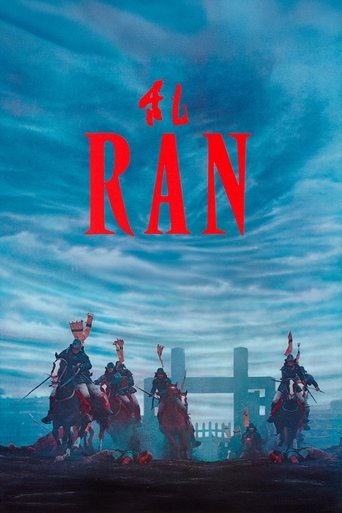
Ran
Where the DNA of Ran travels
Films it shaped
-
In terms of action films, I love Kurosawa's work. His historical epics, like Ran and Kagemusha, taught me a lot about how to handle large crowd scenes and dramatic scope.
-
Yeah, definitely. The big Kurosawa movies, like 'Ran' and 'Seven Samurai.' David Lean movies like 'Lawrence of Arabia,' 'Doctor Zhivago.' Those were my inspirations.
-
I actually saw the Kurosawa version of Ran and Seven Samurai and I was extremely impressed by the way he handled the battles. I learnt a lot from those films. I would say that it had a profound influence on me to create a battle scene that had more humanity, not just bloodshed.
-
Kurosawa is definitely one of the biggest influences for me. Especially with 'Ran,' the way he presented battle scenes and the drama of the people in the middle of it. When I was making '13 Assassins,' I definitely had 'Ran' in mind for its grand scale and attention to detail.
-
Wes Anderson has openly acknowledged that the primary cinematic foundation for his sprawling alpine adventure rests upon the sophisticated comedies of Ernst Lubitsch, particularly The Shop Around the Corner and To Be or Not to Be. Anderson sought to capture the legendary "Lubitsch touch", a remarkably deft, effervescent tone that masks a deeper melancholy regarding the fragility of civilization in the face of fascism. Additionally, the film's intricate tracking shots and sweeping romantic fatalism draw heavily from the elegant camera movements found in Max Ophüls's The Earrings of Madame de.... By channeling these exact works, Anderson crafted a vibrant love letter to a bygone era of European elegance that was largely preserved only in the amber of classical cinema.
-
I look at directors like Kurosawa. 'Ran' is one of my favorite films; the way he directs those battles, the scale, the sense of dread and beauty in the midst of chaos – it’s something that always inspires me when I think about making a big film.
-
Visually, just in terms of big screen scope, I always go back to Kurosawa, particularly Ran.
-
There are a lot of influences, of course, that are there... I mean, I would say 'Ran,' Kurosawa, is probably one of the biggest ones.
-
The whole idea behind Part Two was to make it feel like a very intense, very muscular experience. We watched Ran, we watched Apocalypse Now, for their immersive power, for their sense of scope and how they plunge the audience into the perspective of a character that is confronting the horror of war. And that was very much something that I wanted to capture for this film.