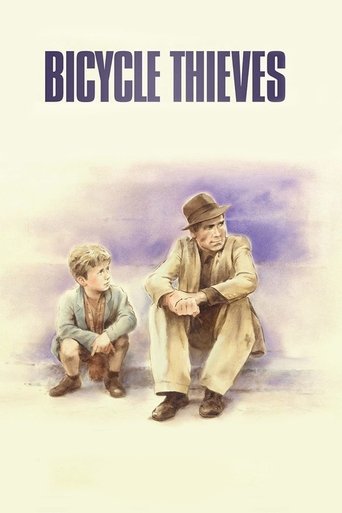
Bicycle Thieves
Where the DNA of Bicycle Thieves travels
Films it shaped
-
The Italian Neo-Realism movement, and De Sica's The Bicycle Thieves and Rossellini's Rome, Open City, were really important. And then the French New Wave, Godard's Breathless in particular, influenced me. The whole idea of a film being alive, on the streets, no sets, capturing the moment – that was the dream for Mean Streets.
-
As Martin Scorsese notes, ‘when I first started seeing films like Saturday Night and Sunday Morning… or A Kind of Loving, there was a social realism, it was a social anger, but it was also a great sense of humour in these pictures. And they were made with a low budget and they were extremely effective. And you saw the influence of De Sica and Rossellini and the Neorealists.’
-
Forman frequently cited the Italian neorealists, particularly Vittorio De Sica’s *Bicycle Thieves*, as a major influence on his desire to capture everyday life with a raw, documentary-like honesty, a style highly evident in *Loves of a Blonde*.
-
We wanted to make a film that had the sense of people actually living, so we worked with a lot of non-professional actors and developed the script as we went along. This approach has its roots in Italian neorealism, in films like Bicycle Thieves, where the lives of ordinary people are depicted with such honesty.
-
Cuarón added that he showed his crew on 'A Little Princess' films by the French New Wave and Italian neorealism, in particular 'Bicycle Thieves' (Ladri di biciclette), as he “wanted to remove the varnish” of the typical studio production.
-
I also deeply admired Italian neorealist films like Bicycle Thieves. The way they captured reality and the lives of ordinary people with such honesty and simplicity really resonated with me, and I tried to bring that spirit to my own work, especially in Platform.
-
Rocky Atlas note
I grew up on Italian neorealism. 'The Bicycle Thief' was always one of my favorites. That gritty, raw realism, that’s what I wanted to bring to 'Rocky.'