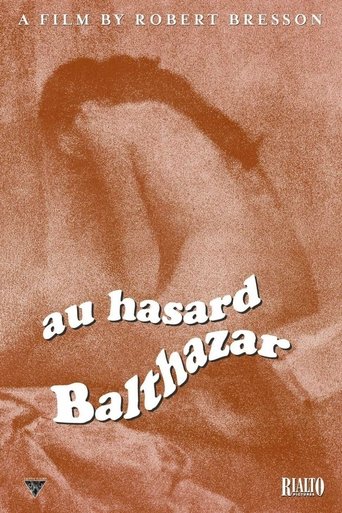
Au Hasard Balthazar
Where the DNA of Au Hasard Balthazar travels
Films it shaped
-
Bresson is a huge influence, of course, for me. Pickpocket and Au Hasard Balthazar are films that... are just really something.
-
Schrader credits Robert Bresson’s Pickpocket and Au hasard Balthazar as touchstones for his early screenplays and direction... for his depiction of alienated characters and his formal rigor.
-
Bresson is a saint. He’s the first director I saw that made me think, ‘Okay, this is what filmmaking is about.’ Before Bresson, I liked movies, but they were just movies. Then I saw Bresson, and I thought, ‘Oh, this is its own art form.’ His rules, his purity, the removal of theatrical acting, the way he uses sound… I love ‘Au Hasard Balthazar.’ I love ‘Pickpocket.’ I love almost all his films.
-
For me, the most important influence was Robert Bresson, definitely... Bresson is the first director who really showed me what cinema is... Au Hasard Balthazar is perhaps the most extraordinary one. Because it's a completely absurd story, but through his method, through his style, he makes it believable and incredibly moving. You feel very strongly with this donkey.
-
There is Bresson as the master, the absolute master of the mise en scène. For us, he’s one of the greatest directors of all time. We feel very close to him. We always look at Bresson’s films with great admiration. And of course, there’s Au Hasard Balthazar, Mouchette, Pickpocket.
-
I watched many films when I was younger, and I learned from all of them. But Bresson was a director I learned from a lot in terms of technique. At some point, I decided to do something different.
-
I’m a huge fan of Robert Bresson and films like Au Hasard Balthazar and Pickpocket. The way he shoots actors is fascinating. It’s a very internal style.
-
He speaks of Bresson’s Au Hasard Balthazar as a particularly resonant work, stating, ‘The film is incredibly emotional, even though the actors are totally flat. It teaches you that you don’t need drama to convey emotion.’
-
Scorsese has explicitly cited Parajanov's Shadows of Forgotten Ancestors as a blueprint for how to photograph spiritual and historical subjects. Not through narrative clarity but through color, texture, the ornamental weight of image itself. In Silence, Scorsese abandons his usual kinetic grammar and enters Parajanov's register: the frame becomes icon, color becomes meaning, and the suffering of faith is rendered not through dialogue but through the flatness and richness of visual information. Parajanov taught that cinema could approach the sacred not by explaining it but by creating a visual texture so dense it becomes incantatory. Scorsese's Silence is his most Parajanovian work, a film where the absence of faith is photographed with the same visual reverence Parajanov brings to presence.
-
We looked at a lot of movies... Not just 'Taxi Driver' and 'King of Comedy,' but also films like 'Network' or 'Serpico.' Even a Robert Bresson film called 'Au Hasard Balthazar' about a donkey, which is really just about a character's suffering.
-
First Reformed Atlas note
I wanted to make a spiritual thriller, an existential thriller, and I thought the elements that Bresson and Bergman and Dreyer and Ozu, the elements that they brought to the spiritual film, could be transmuted into a thriller that would keep the audience on the edge of their seat.